Showing posts with label Guatemala. Show all posts

Sunday, April 04, 2010

Guatemala 2010: Gary's Summary

All I can say is Wow. What a week. I can't believe it's over. It went so quickly, and I am sitting here wishing that I was back in Guatemala - though this time I wish I had my whole family with me.

I was just sitting here thinking about all the things we did over the week. First of all, just a huge shout out to the Kendalls. Without them the whole would not have happened. Carol and Forrest have such a love for the people of Guatemala, and such a desire to do what God has called them to do. We stayed at their house, did the work they put together for us, and generally just enjoyed the time we spent with them.

Here are some of the highlights that I remember most clearly, some of which I've blogged about elsewhere, some not:
  • Four hard-working days in the water filter factory, building water filters for people who desperately need clean water.
  • Many visits to wonderful, loving families filled with people living in abject poverty, yet who were very friendly and loving to us. Multiple times, for example, at Oscar's house, his sisters thanked me for coming by their house and visiting them. As if a visit from me was any great shakes!
  • My wonderful little friend Sandra, whom I simply cannot get out of my mind.
  • Preaching at 2:00am to drunk partiers in the middle of the central parque of Antigua, and having one young man simply say in response to our gospel presentation "Peco" ("I sin" - as if the rest of us don't) and having a young lady look at me pleadingly and say "¿Qué puedo hacer?" ("What can I do?"). Most of the people were laughing at us, of course, but if you can reach even one person it's totally worth it.
  • Since it's fresh in my mind, the conversation I had with our cab driver to the airport in Guatemala City. After he told me that he worshipped God "en mi manera" ("in my own way") and declaring he didn't believe hell existed as a real place, I had the privilege of sharing the gospel with him for the remaining half hour of our cab ride. At the end, he thanked me and we parted pleasantly, me giving him a gospel tract which had thoughtfully been supplied by Carol that morning.
  • The fun restaurant we went to twice, La Peña de Sol Latino, featuring live music. (Their web site appears to be down right now.) One night they had excellent Peruvian music featuring the restaurant's owner (a gringo) on the conga drums.
  • The cultural events of Semana Santa, at once so beautiful and so tragic because so many people are putting their faith in objects of God's creation rather than the God who created them.
  • The warm, friendly people we met everywhere. Nowhere did we have people look at us and say (at least out loud) "stupid gringos". (We were not, of course, acting like stupid gringos, which no doubt helped greatly.)
  • All the people I gave tracts to. I can remember many of their faces and am praying for each of them. I remember especially well all the people working around La Merced cathedral. I walked up to each of them and said something along the lines of "Gracias por su servicio aquí ... Puedo ver que está interesado en cosas espirituales ... ¿puedo darle un regalito con más sobre Dios?" ("Thanks for your service here ... I can see you are interested in spiritual things ... can I give you a little gift with more about God?") I even - what can I say, I'm getting bold in my old age - approached several nuns and gave them tracts.
  • An excellent new book I found called Correct Your Spanish Blunders. In my opinion, this is the second-best book on fine-tuning your Spanish I have ever found (second only to Breaking Out of Beginner's Spanish). I will be ordering this from amazon tout de suite.
All in all, we spent several hours at church, probably 6-8 hours in evangelism, a few hours simply enjoying the culture, and the rest of the time in service to the people of Guatemala. I have very few regrets about my time there: perhaps my only real regret is not making more of an effort to talk to the Mormons that I saw several times in Antigua.

So ... where do we go from here? Honestly, I'm not 100% sure. One thing I know: I am praying that God never lets me be the same again. If you can go to a place like Guatemala and come out unchanged, there's something wrong with you. I am sincerely praying that God does not let me be like that.

One tentative thought I had: there are so many people with needs there that you cannot fix everybody's situation. However, you can help people you have a connection to. So, I will be pondering and praying over the next days and weeks how I might be able to help Sandra's and Oscar's families. One thought I had was that since education is the way out of poverty for hard-working people like Oscar's and Sandra's families, and it costs money to send kids to school, perhaps we could sponsor a few kids to go to school.

Ja will follow up with a final posting of his thoughts after this amazing trip. For now, God bless all, and I'm off to bed. Work tomorrow ... let's just say that I'm not looking forward to getting back to work. I am thankful that I have it, if for no other reason than I can make money to go on wonderful trips like Ja and I have just made.

Saturday, April 03, 2010

Guatemala 2010: Street preaching

Wow! What a 24 hours was Good Friday! It all started at 1:00 in the morning...

According to our schedule for Semana Santa, the celebrations started at 1:00 am and went all night long. So, we got to bed early to try and get a little sleep before going down there. I got about an hour and a half's sleep - unfortunately, Ja did not get any - before having to wake up to the alarm at the unholy hour of midnight. But, in for a penny, in for a pound: so down to La Merced we went for El Pregón de Sentencia, or the presentation of sentencing. The processions actually follow the Biblical time sequence fairly accurately, with Jesus going on trial in front of the Sanhedrin in the middle of the night and moving on to Pilate after daybreak. The Kendalls told us we really should go down there to see the beautiful alfombras, so off we trudged. The sentencing consisted of Roman soldiers in full Roman dress uniforms on horseback, along with a soldier announcing Jesus' sentence of death. Unfortunately, totally out of character for Guatemala, the Pregón actually took place ahead of schedule, so we missed it. What are the odds of that! Thankfully, like all processions, it moved from place to place, with the soldier repeating the sentence periodically; so we were able to see one of the later presentations.

Having missed the pregón itself, we decided to drop by the café of the church where we had attended on Sunday. Earlier on Thursday night, we had gone in there before attending church and had been told they'd be open all night and that a group of them might go out and do some street preaching. There, we met up with Mark, a fine Christian gentlemen with a great passion for reaching the lost who was indeed going out to preach. Yes, street preaching: that Rob Bell-lambasted "Bullhorn Guy" activity where you go out and preach the gospel to unsuspecting passersby. I have long said that Rob Bell has no idea what he is talking about; that every person I know who has come to faith as an adult that I've discussed the question with has been positively influenced by a street preacher somewhere along the line. I vividly remember seeing street preachers on the quad at George Mason University back in the late 80s; though I didn't come to Christ right then and there, I definitely remember them as somebody who I respected for their faith and zeal even though I did not (at the time) share their religious convictions.
Note to Rob Bell: open your ears to what us real adult converts have to say. Be thankful for your sheltered Christian-from-birth bubble, but don't just stay in there and assume you know how everybody else thinks. Some of us who come in from the outside just might know better what non-Christians like we were need to hear. (Not to mention the way the Bible presents the gospel.)
Anyway, though I had long been in favor of street preaching, I had never done it: in fact, it scared me to death. But when we heard that Mark was going to go and do it, we decided to join in with him. So, out went our little rag-tag group of four: Mark, our fearless leader; Dave, Mark's assistant and straight man; Ja, who speaks little Spanish but the rest of us could translate, and myself. Ja and I had never street preached, but we still felt fairly well equipped from the Way of the Master basic training course we had gone through. Now was our chance to use it. Yikes!

By the way, let me get in a plug for Way of the Master: I strongly believe that every Christian should watch these videos and put them into practice. If you are uncomfortable with sharing your faith with people, Christian, go to the link above right now and order the course. Or, if you want to go down to Guatemala and experience the training along with evangelism opportunities just like I'm describing here, Mark is holding an Evangelism Bootcamp June 20-26. This would be a great chance to get trained using excellent materials and get an awesome chance to practice in the same live environment where we were, for a very reasonable price. Maybe Mark will even take you out in the middle of the night. :-)

We spent the next three hours walking around the central park area of Antigua, sharing the gospel with whoever we met there. The Way of the Master method is quite simple: you essentially follow the first three chapters of Romans. You first present the bad news, then you present the Good News. That is, you present the law of God in the form of the ten commandments, and demonstrate that all your listeners have broken them. For example, Thou shalt not bear false witness. Have you ever told a lie? If so, what does that make you? The obvious answer is "a liar." The Bible says that all liars will have their part in the lake of fire. Next, Thou shalt not commit adultery. Have you ever looked a a member of the opposite (or same) sex not your spouse with lust? Jesus said that's the same as committing adultery in your heart; thus, that makes you an adulterer-at-heart. After presenting three or four commandments and have the listener admitting that he has broken all of them, you help them to understand that they do not deserve heaven, they deserve hell. Once they have that understanding, then (and only then) do you share the Good News: that Jesus Christ died to take the penalty that they deserve, and by putting our faith in Him and Him alone, we can be freed from the penalty that we all deserve. Straight out of Romans.

It might seem that it would not be a fruitful place to preach, as most people in the park at 1:00am were drunk, but it was. Though we didn't have anybody put their faith in Christ right then and there, there were definitely a number of people who were under strong conviction by the Holy Spirit. One young lady, after I had explained about the ten commandments and how breaking them meant she was headed for hell, looked at me with a blank look in her eye and asked "so what can I do?" At that point you have the privilege of explaining that putting your faith in Christ's sacrifice, not in your own works, is the way of salvation. It's such a freeing truth! And, I should note, one that friendship evangelism would most likely never have provoked.

We were actually interrupted one time by an intelligent but militant atheist heckler who wanted to argue about the injustice of God using regurgitated quotes from Christopher Hitchins as well as scatter-shot fired objections he seems to have actually thought of himself. Mark was preaching at the time, and his lack of facility in Spanish actually came in handy: the atheist switched to English and continued the argument while Dave and I talked to the crowd. Ja then came to our rescue and took the atheist aside and talked with him for awhile (I'm very proud of that boy) so Mark could return to talking to other members of the assembled crowd. It all turned out very well: you might even suspect that God had a hand in the whole thing. (Wink.)

After three hours of exhausting preaching we returned to the church café for a cup of coffee and cookie, and off to bed. (Ja, of course, had a sandwich. He earned it.)

The next afternoon, after sleeping in, we went out to the market to buy a few final souvenirs. As we were walking around the market, we happened to see a street preacher we didn't know walking through the market and evangelizing. After listening for a few minutes to convince myself that he was doing solid Biblical preaching (you can't be too careful), I struck up a conversation with him. We talked for a minute and then we both spontaneously started talking in raised voices. I found myself again preaching in Spanish to a rapidly assembling crowd right there in the middle of the market! I suspect the fact that we were a gringo together with a Guatemalteco that attracted people's attention, but so what? Once they started listening, they could hear our gospel presentation. Once again, we had a number of interested listeners. I handed out as many gospel presentation tracts as I had with me to our listeners. Ja did a double take and said "where did you get those from?!" as I had apparently produced them as if out of thin air. Thankfully, I had brought along a handful for just such an occasion: it always pays to be prepared. I could have given out two or three times as many as I had to the eager recipients.

So, we had an extremely exhilarating but exhausting 24 hours. There were a minimum of 8 people who I believe were genuinely under conviction by God's Holy Spirit. Since then, I have been praying for them. I would appreciate your prayers for them, too.

Before I close, let me make an aside to those readers who are not evangelical Christians. Most people in Guatemala are Catholics, but we were emphatically not out there to get people to change churches. Good evangelists never do that. If an evangelist is trying to get you to join his particular church, run away, and FAST. (Well, either that, or evangelize him, like I do with the Mormons and Jehovah's Witnesses who show up at my door.) That's not what the Bible calls us to do. It calls us to introduce people to being in a relationship with Him, the living God of the universe, NOT to join a particular church. My primary desire is to see people come into a live-giving relationship with God; I trust that the same God who can save them will lead them to being in whatever church He wants them in. If God leads them to stay in their own current church, that's wonderful; if He leads them to leave, that's great too. I figure God can choose what church they should be in way better than I will ever be able to. Do I encourage them to join a solid church that teaches the Bible? Absolutely. But that doesn't mean that my church is the only place that does it.

Friday, April 02, 2010

Guatemala 2010: Experiencing Semana Santa

As you can tell from all of our other posts, we are primarily down here to help build and install water filters. The water filter and other humanitarian efforts consumed almost every day. However, by a somewhat unfortunate coincidence, our trip is happening over what they call "Semana Santa" or "Holy Week" here: "holy" because it is the week leading up to Easter. In this culture, unlike the US, Semana Santa is a huge deal. The reason I say "unfortunate" is that during the latter part of the week (now), it's impossible to get anything done or even to get anywhere. That is, impossible to get anything done because everybody has off work, and impossible to get anywhere because of all the "processions." On the other hand, it was an excellent cultural experience, and gave us a chance to do some street evangelism, as described in the next posting.

At right you see a picture of one of these "processions". In addition to marching bands and long lines of people dressed up in special costumes (purple and white robes for the men, black dresses for the women), they have special floats used only in Semana Santa called "andas". "Anda" is Spanish for "walks", perhaps so called because the float travels by being carried on the shoulders of men or women walking down the street, or maybe because as it goes down the street it sways from left to right like some giant drunk caterpillar. As you can see, these can be rather large: for the anda above, there were probably close to 50 men carrying it, plus men at the front and back to help steer it; the even larger one below may have as many as 60.

Through Semana Santa, the different processions commemorate different activities in Christ's last week before His crucifixion. The anda at left is probably the most spectacular one, all lit up with a glass coffin in the middle with a statue of Jesus in it. We thought it looked like a small cruise ship, all lit up as it was. Following this anda there was, as with most andas, a band following playing music that they obviously felt was appropriate.

Another amazing feature of Semana Santa is the beautiful alfombras ("carpets", an interesting word for which Spanish speakers no doubt owe thanks to the Arabs that populated Spain for hundreds of years) that people make in the streets. These alfombras are typically made with a base of either colored sawdust or pine needles; beyond that, almost anything goes. The one at right is made entirely of sawdust: they put down pieces of wood for the edges and start filling in with sawdust. Then, after building up a base layer, they start adding layers of other colors using wooden stencils or sometimes freehand. Many alfombras, especially later in the week, are much more elaborate: examples of some I saw had birdcages all down the center, thousands of fresh-cut roses, or birds carved out cantaloupes and watermelons. Nobody is allowed to walk on these until the andas pass by; immediately after, street cleaning crews come along and sweep up the remains. Thus, these beautiful artistic "carpets" take many hours to create but sometimes only a few minutes before they are destroyed.

The entire week is dedicated to two things: the grisly death of Jesus, and the victory of Mary (or "la virgen" as they call her). Though I don't have any problem with portraying the death of Jesus as what it was, to focus on solely that is only half the story. As Carol, our hostess, pointed out, though there were many processions and events associated with Jesus' death on the cross, in the entire city of Antigua, there is not one single official ceremony associated with the resurrection of Jesus. On the schedule they gave out, there were indeed two resurrection events... but they were both in different towns. Nothing in Antigua.

This is amazing to me. Now, in the US, Christian churches may not perfectly portray the death and resurrection of Jesus, but at least the resurrection (aka, Easter Sunday) is a widely celebrated event. In Antigua, it's virtually unknown. This is really presenting only half the story. And, as Paul wrote in 1 Corinthians 15:16-19:
For if the dead are not raised, not even Christ has been raised; and if Christ has not been raised, your faith is worthless; you are still in your sins. Then those also who have fallen asleep in Christ have perished. If we have hoped in Christ in this life only, we are of all men most to be pitied.
This is exactly the situation of so many people in Guatemala: dead in their sins. Of course, that is true of most of the people in the United States also. However, the thing you cannot miss about Guatemala is how religious the people are. Men pay significant amounts of money to carry the andas on their shoulders in the parades. Why? I believe, at least in part, it is so that they can do penance for their sins, trying to work their way to heaven. As Todd Friel has said recently on a Wretched Radio broadcast, when you remove the law of God (the ten commandments, etc) you always find legalism taking its place. We are all born Pelagians and unless born again, we will always try to work our way to heaven.

In the case of many (not all, of course) Guatemalans, they substitute a faith in Mary to save them. The number of andas carrying statues of Mary were staggering. For example, there was the procession that featured the anda shown above, where Jesus was suffering under the load of carrying his cross. What shocked me was that, immediately after that anda with the suffering Jesus, came an anda with a triumphant Mary (shown at left). Think of it: Jesus couldn't take the punishment, so Mary comes along to make everything right. Another example is in the "La Merced" cathedral, which is a beautiful church; but the centerpiece of its altar is a small suffering Jesus on the cross, with a huge triumphant Mary above. I wish I could say these were isolated examples, but, sadly, they are not.

Now, don't get me wrong: I have great respect for Mary. As the mother of Jesus in His earthly incarnation, she was greatly honored among women. But, as she herself says in Luke 1:46-47:
"My soul glorifies the Lord, and my spirit rejoices in God my Savior..."
Mary knew that she needed a Savior, just like the rest of us. And it's clear that she knew that Jesus was that Savior.

Also, don't get me wrong in thinking that I condemn the Semana Santa proceedings. Some evangelicals do, especially native Guatemalans: I do not. In fact, many of the processions and events are very beautiful, and show a deep reverence for Christ and for what He did for us on the cross. No Christian should ever forget that, and I do not see a problem with graphic reminders. The problem I have is that these sorts of things can very easily take on a life of their own, and become more important than the original thing which they are commemorating. And it's very clear that so many people in the city have made this mistake, worshipping and serving created things (as Romans 1:25 reminds us) rather than the Creator, who is forever praised. Amen!

Wednesday, March 31, 2010

Guatemala 2010: Building water filters

Three of our days down here have been spent building and fixing water filters. This was originally the primary ministry of the Kendalls down here in Guatemala: at first, Forrest built and installed all the filters himself. At left you can see a filter that's used by Forrest at the filter factory. It's really just a concrete box with a "nose" on the front - Ja and I think they look like tiny Easter Island heads. As explained in the wikipedia article, you pour dirty water in the top, and it filters down through the layers of "schmutzdecke", sand and gravel: when it reaches the bottom, it's clean. There's a small device to collect the water - a plastic bottle cap - and a plastic tube that carries the water up the side and out the end of the "nose". You can see the plastic tube sticking out in the picture at left.

Watching them, I was thinking how Forrest and Carol make such a great team installing the filters: Forrest sets them up, while Carol teaches the women how to use them properly. The latter part is extremely important, because although the filters are pretty tough, the biological filtration system needs to be handled properly. They need to use it regularly, keep water flowing through it (to ensure the schmutzdecke stays alive), regularly clean the spout, make sure they use clean buckets to catch the water, etc.

What many of the people will do without this training is actually fairly amazing: they will take their buckets off the ground, fill them with dirty water, pour the water into the top of the filter, then put that same bucket under the spout to catch the clean water (thus contaminating it). Or, they will take a bucket of clean water and then dip a dirty cup into the clean water. Or, they don't keep the lid on top of the filter and (as happened to one filter in Tzancha) there were disease-carrying cockroaches living in the top. So Carol needs to spend considerable time with the women explaining to them how to properly use the filters and keep the clean and dirty water separated and prevent contamination. Clearly, a lot of this has nothing to do per se with the filter: they need basic instruction in hygiene. Carol takes on most of this training, usually requiring the services of a local translator to translate from Spanish to whatever Mayan language that particular group speaks.

If there's any question as to why they need these filters, just take a look at the picture to the right. This is a picture I took looking towards upstream over the river that flows behind Forrest's water filter factory. Notice all the pipes sticking out of the wall of the housing units: those are sewer pipes, dumping raw sewage directly into the river. People either take water directly out of this river to drink, or at best use a municipal water supply which is barely processed. I also learned that the municipal supplies often stop working for days at a time, which means back to the rivers they go.

So, the filters are something they badly need whether they know it or not. After the filters are built, they have to be delivered and installed. As I said, they are pretty tough, but they have to be used properly to ensure that the bio layer continues working properly, and occasionally the filters themselves have problems. For example, while we were in Tzancha we learned that a number of the filters had developed a problem wherein the water went in clear and came out yellow and smelling bad (though tasting ok). So, part of the job of installing filters is going back periodically and checking that they are working properly, and replacing or fixing them when they are not.

The trip to Tzancha (where I met my young friend Sandra) was exactly this kind of "checkup" trip. On this trip, Carol took along a bunch of buckets with covers on top and a spigot on the bottom. I asked what they were and she said "bribes." What she meant was that she checks whether they've been using their filter properly and, if so, she gives them some kind of gift: an incentive to do it correctly. In this case, the bucket (shown at right). The bucket turns out to be extremely important: as explained above, it's important to catch the water from the filter in a clean container and then ensure the water is not contaminated before they use it. The bucket is perfect: they use it only for clean water, it has a cover to keep out flies, and a spigot so they don't dip their dirty cups and bottles into the clean water supply.

The construction process itself is quite interesting: they use steel molds in the shape of the filter, then surround the center part with chicken wire to give the concrete some strength in tension. Then they run the plastic tube down the side and pour concrete into the mold. After the concrete is cured, they remove the mold. At this point, the filter may be ready to install. I say may be because there are a variety of things that can go wrong, from cracks in the concrete to fixes that are necessary because of changing filter designs. In the filters at left, a change in design from the organization the Kendalls work with required us to cut off the "noses" of the filters so that the outlet tube was approximately an inch higher than where it was poured. So, we had to cut off the noses with a diamond blade saw and then patch things up with fiberglass cloth and epoxy resin. (The resin is the dark stuff you can see around the noses.) Also, a number of them leaked because they were incorrectly de-molded, so we had to patch the bodies up, as we did with the filter on the left.

This is clearly a fairly labor-intensive job, so the Kendalls have now trained a number of other people how to build and install these filters. I asked them how many filters they had put in here and they didn't know: over a thousands was the best guess (including all the filters put in by people they trained). That's excellent: teach other ministries how to fish instead of just giving them fish, and let them multiply the filters in this country that needs them so badly.

Tuesday, March 30, 2010

Guatemala 2010: From Ja, Tuesday

Hi, everybody. This is the first blog I've written for this trip. I can say so far it has been a great experience. As my dad has no doubt told you in the previous entries, we have met warm, loving Christians and built water filters. Today, we went to a refugee camp called Tzancha, where refugees from a landslide 5 years ago were living to install a water filter for a family. The particular family there already had one but it wasn't working properly (it was later determined that the problem was that the sand was bad).

It was kind of like being in the home of a family that everyone loves. The people staying in the house were very friendly and were Christians. The children, besides being adorable, were happy, playful, and respectul. The only difference: Instead of living in a nice, furnished American home, these people were living in poverty. The first thing I noticed about the place was how dirty it was. There was dirt and trash everywhere. There were flies everywhere. Now that their water filter had broken, they didn't even have clean water to drink, meaning that they could very possibly get diseases from the contaminated water. Many of the people, including the children, had lice and scabies. And still, these people were happy. Here's what hit me: how many of us in America, even Christians, would dispair and hate life if they were put in these conditions?

Of course, you might say that it's easier for them because they've been living like this for their whole lives. This is true, but an important point still stands: you don't need money, or a nice house, or any of our material possessions to be happy. All they needed to be happy was their family, their friends, and God. They were living close to their friends and family, they were strong in their faith, and they were happy. This point is something many Americans need to hear amidst the hustle and many times self-centeredness of our lives.

Looking forward to the rest of the trip, I'll blog more later.

-Ja

Guatemala 2010: Que te presente a mi amiga Sandra

Let me introduce you to my friend Sandra.

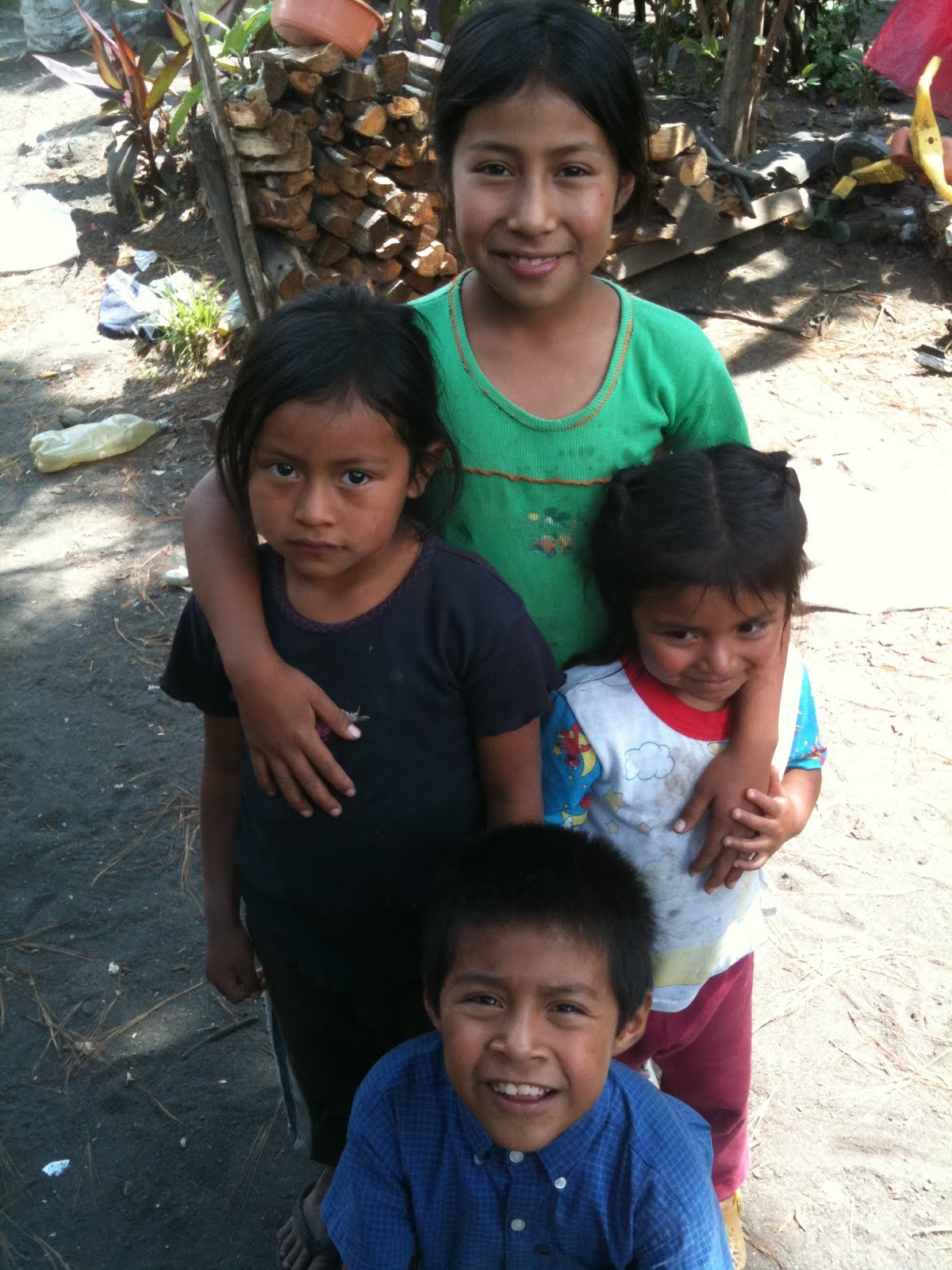
She turns ten years old in May, is just as cute as can be, and has a bubbly personality and infectious smile. In fact, she reminds me very much of Danning. She latched onto me as soon as we got there today. Where is "there"? A refugee camp called Tzancha (pronounced "san-CHA"), originally created for the victims of the mudslides caused by Hurricane Stan back in 2005. It was supposed to be a temporary location for the refugees, six months maximum. Five years later, they're still there.

Sandra speaks perfect Spanish, extremely scanty English - but she's eager to learn more - and her native language, Tz'utujil ("su-tu-HIL"). One of the many surprises that awaited me in Guatemala was that many of the adults in these areas don't speak Spanish. Rather, they speak Mayan languages. These languages are all different, but it appears they are related; I learned to say "thank you" in Tzutujil you say "mat-i-OSH", while in Kaqchikel, the language of my friend Oscar, they say "MET-i-osh". I have no idea how to spell these words. Thankfully, Sandra's Spanish is excellent, so she and I had no problem talking all day.

It is really amazing when you think about it: here's a ten year old in Guatemala who speaks some ancient (and nearly extinct) Indian language, and an old gringo like me from the US who speaks English, yet we could communicate perfectly using Spanish. I keep thinking of C.S. Lewis's saying: "Ïf you aim for heaven, you will get earth thrown in in the bargain; if you aim for earth, you will get neither." It's the same here: I have no doubt that if I learned Spanish to take part in the rich Hispanic culture, eventually it would get old; because I learned it to minister to Latinos, I get the culture thrown in in the bargain, and get frequent delights. Since I was in Spanish school in Costa Rica, I have never spent so much time in a day speaking Spanish. 2.5 hours in the car each way sitting next a friend of the ministry, Christy, who spoke only Spanish and three hours or so playing with the kids and talking with their parents.

At one point, my young friend proudly led me back and showed me her family's garden: a small plot with strawberries, tomatillos, and other types of plants growing there. There were also chickens running all over. ("Cuál es tu comida [food] favorita?"I asked her. "Pollo"- chicken - she responded.) It's amazing that all these people can live on this amount of food, but I think they also bring limited amounts in from the outside: they were making tortillas, though I saw no corn growing nearby. That was something else I learned: here in Guatemala, they eat tortillas made of corn - not wheat as in Mexico and Costa Rica. They also enjoy that tasty dish made from corn tortillas and cheese or chicharones: the pupusa. I always thought pupusas were a purely Salvadoran specialty.

I spent several hours playing with Sandra and her siblings and cousins. We had so much fun, but it is really sobering to think not only that these kids are growing up in terrible poverty, most have lice and many have scabies. It's heart-breaking to think of it. Thankfully, there are a number of excellent ministries like Servants4Him down here trying to help as much as they can. They support the health of the people in many ways: water filters for clean water, medicines and other health supplies, medical and dental clinics, and various types of health classes. Yesterday, while we worked on the water filter - and I kept the kids busy - Carol Kendall and Christy did a class for the women in the village, teaching them how to keep their families healthy. (One of the suggestions on the instructions they gave them: "Bathe frequently, at least twice a week." That's "frequent" down here.) They needed a translator: one young lady who looked like she was about 14 translated for them from Spanish into Tzutujil.

One final delight: one of them was tapping on a rock with a large bolt, so I started drumming a rhythm with my hands on a bottle of bleach. Sandra went and found a few empty plastic bottles and a bucket, so we started all playing music together. I asked if there were any other instruments around and one of the kids brought over an old plastic xylophone. I played "Jesus Loves Me"and they all joined in: "Jesús me ama, Jesús me ama, Jesús me ama, la Biblia dice así." Several then sang other Sunday school songs for me.

Think of it: an impromptu jam session with kids in a refugee camp singing in our shared secondary language in the hills of Guatemala. Truly, I aimed for heaven and got earth thrown in.

Monday, March 29, 2010

Guatemala 2010: Concrete is your friend

Many of the things that the Kendalls install down here are made of concrete. At first it doesn't make a lot of sense: it's heavy, can break if mistreated or overheated, and carrying it into the country would be prohibitive because of the weight. However, the more I thought about it, the more it made sense. It's strong, it's durable, it can be used to fabricate many different kinds of structures and objects, and best of all it only requires one component to be brought in from outside: bags of cement. The rest of the components of concrete - the sand, the water, the stone aggregate - are all readily available locally.

Two of the objects the Kendalls install in people's homes are water filters and stoves. Both are made primarily of concrete. On the way back from Oscar's house, we got to visit the factory where they construct the stoves. At right is one of the stoves they install. There are several models, but this one has a number of useful features including "wings" on the sides that can act as counters or tables. The stoves are very important because without them, the people need to use open-air fires, which are extremely inefficient: more smoke, less usable heat. Note the parts of the stove: the base, the firebox (which has wood sticking out above), and the "plancha" or steel plate on top. This gives them the closest thing to burners they get. Building the stove correctly is very important, because one of the many things we learned about concrete was that if it is subjected to too much heat, it breaks.

The stove seen above was actually in use at the stove factory, which is operated by a friendly entrepreneur with the solid Roman name of Marco Tulio, shown at left. (For those who forget their ancient Roman history, the personal names of the orator we know as Cicero was Marcus Tullius. I understand that this is a fairly common name down here in Guatemala.) Marco Tulio makes stoves for the Kendalls' ministry, as well as a number of other groups down here: many of the stoves we saw had the Rotary International insignia on them. He's got a fabrication process down so he can sell the stoves to ministries and clubs like Rotary as inexpensively as possible.

The Kendalls install stoves they buy from Marco Tullio's factory, but their primary ministry has always been installing water filters. They construct the water filters themselves, in their own factory. For several days now we have been working in the water filter factory, learning a bit of concrete work while we're at it. The filters use a technology called "BioSand". Here's a wikipedia article on BioSand filters, but the upshot is that there's a layer of sand that filters the water with a "schmutzdecke", or "slime layer". The filter is also made of concrete, meaning it's quite heavy, but also very durable.

Concrete also gives families the only real floors in their houses they have. Wood floors are unknown: it's either concrete or dirt. (Wood is either used for furniture or, perhaps more often, to make the "native crafts" sold in the markets and the airport.) And many floors, unfortunately, are just dirt - or, in the rainy season, mud. So, concrete floors are almost a luxury - not to mention being much more sanitary than dirt.

Saturday, March 27, 2010

Guatemala 2010: Day one

We arrived here in Guatemala yesterday. We are staying with Kendalls, who are a wonderful husband-and-wife team with whom we used to attend church together at Grace Bible Church. They decided about 7 years ago that God was leading them down here to Guatemala and have been here ever since. They have a ministry, Servants4Him, which started as a ministry where they install water filters. We in the US don't recognize it, but most of the world does not have access to a source of clean water. The water most of the people use here is either straight from a (usually dirty) stream, or at best from the municipal water supply. They do some processing on the water, basically allowing sediment to settle out and then treating with a small amount of chlorine. The "small amount" means that one day a week they add some chlorine to the water, which means, as Carol explained it, if you get water on the day they add the chlorine, it's not too bad... but if you get it six days later, it's in bad shape. So, they build and install water filters - which I will tell more about in a later post.

Like many countries of the world (or parts of the US), Guatemala is a land of contrasts. There are (a few) very nice houses in gated communities, right down the street from people living in incredible poverty. We visited one such family today, shown in the picture above. This is the family of Oscar (the young man at the left side of the picture above, whom the Kendalls try to give odd jobs to whenever they can). There were 21 family members living together on a small, filthy plot. Part of it had concrete floors, and part had actual block walls; but even this is better than many people. Apparently they have relatives who work in the US and send money back home. Unfortunately, even this does not help their standard of living very much. The clothes they wear are either ones they make themselves (and sell at the markets to the tourists) or else second-hand or factory seconds sent from the US and Canada.

The children seemed to be relatively happy, climbing all over each other and us. However, in talking to our host in the house (seen at left in the picture above), they frequently need medicine. He also told us his youngest, a beautiful little one-year old girl, constantly suffered from "mal del estomago"- i.e. pains in her abdomen. I had always had the idea that locals get some kind of immunity in their systems to combat the bad water - turns out they just get used to it and don't complain too much. It bothers them nearly as much as it bothers us gringos, we just complain more. What pained me also to see was that many of the youngsters had massive tooth decay. For several, all their front teeth were black and eaten up at the edges. I now see why Forrest and Carol, in addition to their water ministry, also sponsor periodic dental and medical clinics.

I can really see the all-around ministry the Kendalls have. When they are in a person's home, they often note other things that need to be done to the home. In Oscar's home, they noted that they don't have any good stove - they just cook on an open flame. Not only does this cause a lot of smoke in the house ("hay mucho humo" as the matron of the family told me), open fires are also very inefficient. And since they have to gather wood by hand and carry it back to their house (we saw several families doing just that on our way back yesterday), efficiency is a big deal. Oscar told me they spend four hours every day just gathering firewood. What's more, the kitchen roof was just a piece of corrugated steel that not only didn't cover all the area, it was actually sloped in the wrong direction, so all the rain pours right into their house. So, the Kendalls are planning on also installing a new, efficient stove and replacing the roof. More on stoves in my next installment.

Guatemala is a wonderful land with more people with needs than one could ever fill. You could easily completely lose yourself in people's needs and end up burning yourself out. Or, like most of us, we can not fill them. Best of all, like the Kendalls, you can fill people's needs but try not to get completely consumed. My hope is that more of us - myself inclueded - take more after the Kendalls.